

From Bean Belt to Coffee Cup
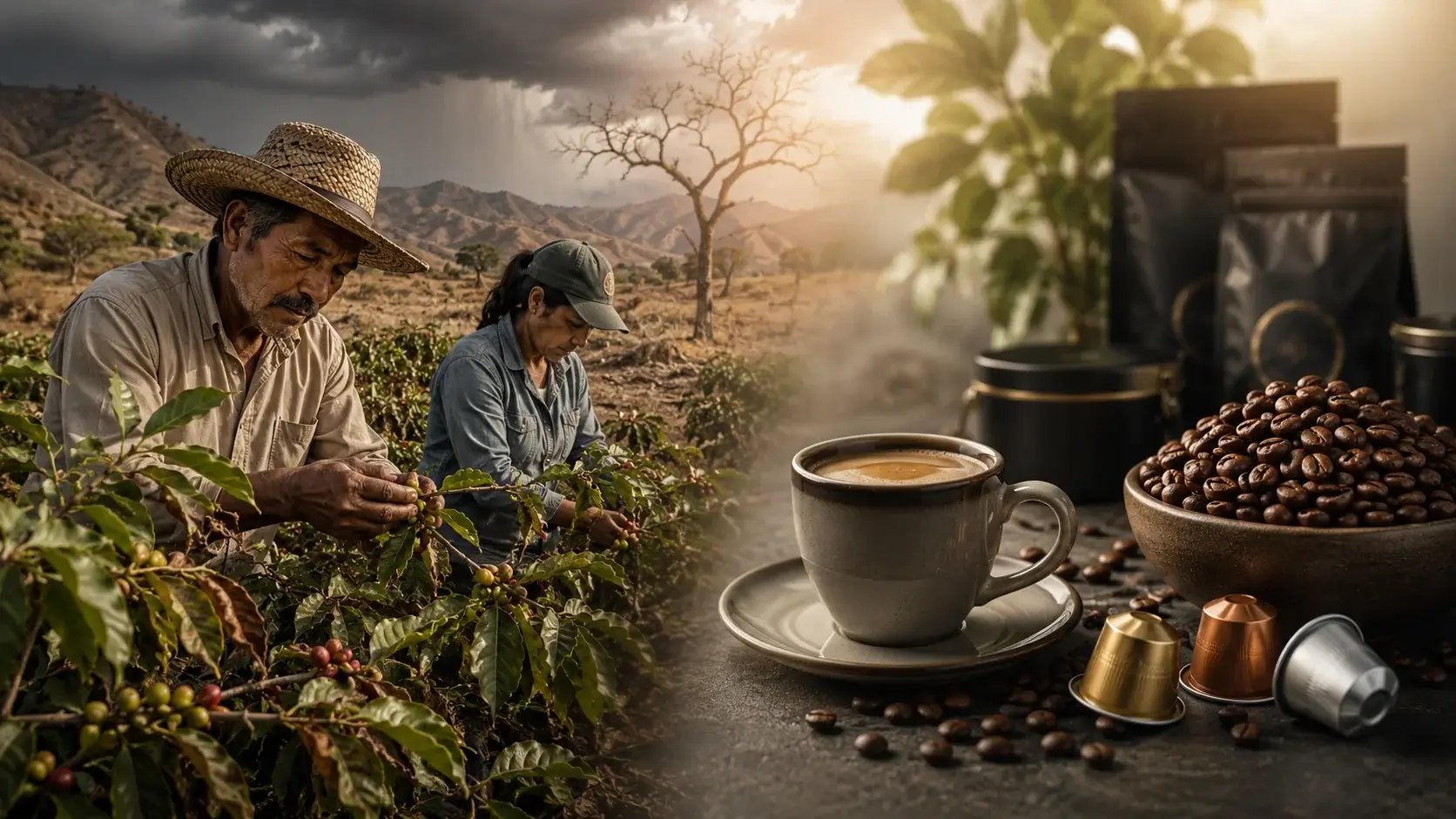
How Climate Is Reshaping Coffee Production and Consumption Around the World
A deep-dive for coffee professionals, private-label roasters, and capsule brands navigating a rapidly changing global supply chain.
Introduction: The Climate Variable That Is Rewriting Coffee’s Story
Coffee is, by virtually every measure, the world’s most beloved traded commodity beverage. Roughly 10 billion kilograms are consumed annually, supporting an estimated 25 million farming families, spanning more than 70 countries across four continents. It is a drink woven so deeply into daily life, from the Norwegian kaffepause to the Emirati afternoon espresso, that it is easy to forget just how climatically fragile the chain of events required to produce it truly is.
That fragility is no longer theoretical. In late 2024, Arabica coffee futures reached a 47-year high, driven by Brazil’s most intense drought in decades and poor harvests in Vietnam. By February 2025, the C-market price for Arabica had climbed to $3.84 per pound, a price level not seen since the late 1970s. For private-label roasters and capsule producers, green coffee costs jumped from representing 40-50% of production costs to an alarming 60-70% within just two years. These are not temporary market fluctuations. They are early signals of a structural shift, one driven by climate.
This article examines the full arc of that shift: from the extraordinarily precise growing conditions that coffee requires in its producing countries, through the specific climate threats now destabilizing each major growing region, to the changing face of consumption in both hot and cold-climate countries, and what it all means for the businesses that turn green beans into the billions of capsules, cups, and cans consumed every day.
Part One: The Climate Science of the Coffee Bean
The Bean Belt — A Narrow Window of Possibility
All commercially significant coffee production occurs within a narrow equatorial band informally known as the “Coffee Belt” or “Bean Belt”, a strip of land stretching between roughly 23.5 degrees North and 23.5 degrees South of the equator. This zone, encompassing Central and South America, sub-Saharan Africa, and South and Southeast Asia, delivers the very specific convergence of temperature, rainfall, altitude, and soil chemistry that coffee plants require to produce commercially viable, high-quality beans.
The two commercially dominant species, Coffea arabica (Arabica) and Coffea canephora (Robusta), have meaningfully different climate tolerances, and this distinction matters enormously for everything that follows in this article.
Arabica, which accounts for roughly 60% of global coffee supply, is the more climatically demanding and more commercially prized of the two. Arabica thrives in temperatures of 18-22°C (64-72°F), requires 1,500-2,000 mm of well-distributed annual rainfall, needs a distinct dry season of two to three months to trigger flowering, and generally performs best at altitudes of 600-2,000 meters above sea level. Temperatures consistently above 30°C are growth-limiting; even moderate sustained heat stress disrupts flowering, accelerates cherry ripening (reducing complexity and flavor), and reduces bean density. Frost, even brief and mild, can be lethal.
Robusta, the hardier cousin used extensively in espresso blends and instant coffee, tolerates temperatures of 22-26°C (72-79°F) and can be cultivated at lower altitudes, from 200 to 800 meters. It produces a bolder, more bitter cup with higher caffeine content, and is generally less susceptible to disease — attributes that have made it increasingly attractive as climate conditions deteriorate at lower elevations.
At higher elevations, cooler nights slow the maturation of coffee cherries, allowing sugars and flavor-active compounds to develop more fully. This is why altitude is so closely correlated with cup quality in specialty coffee: the best Arabica-growing farms in Ethiopia, Colombia, and Central America sit at 1,500-2,200 meters, where the combination of temperature modulation, intense equatorial sunlight, and mineral-rich volcanic soils produces beans of exceptional complexity. When that temperature window shifts upward due to warming, the only short-term response available to farmers is to plant higher, and there is, ultimately, a finite amount of mountain available.
Specific Climate Parameters That Make or Break a Harvest
For those in the coffee industry who source, roast, or pack green beans, understanding exactly which climate variables are decisive is essential for anticipating supply disruptions.
Temperature is the most critical single variable. Research consistently identifies 30°C as a threshold above which Arabica plants experience measurable physiological stress. A Climate Central analysis of temperature data from 2021 to 2025 found that climate change was already pushing temperatures past this coffee-harming threshold on additional days each year across 25 major producing countries, days that would not have exceeded 30°C in the absence of human-driven warming.
Rainfall timing and distribution is perhaps equally important as total volume. Coffee requires not just sufficient annual rainfall, but rainfall that arrives at the right times. The dry season triggers floral initiation; the subsequent wet season supports cherry development. When rains become erratic, arriving too early, too late, or in violent short bursts rather than steady seasonal patterns, flowering is disrupted, cherries develop unevenly, and post-harvest processing becomes difficult. A UCLA/NOAA study found that since 2000, increased evaporation driven by rising temperatures now accounts for 61% of drought severity in major producing regions, meaning drought conditions are worsening not only because of reduced rainfall, but because the heat is evaporating available moisture faster than before.
Altitude and land availability interact with both of the above. As warming pushes the viable temperature band upward, coffee-suitable elevations shift higher. Projections suggest that by 2050, suitable growing elevations will have shifted upward by more than 300 meters in many regions, with implications both for the total land available and for the ecosystems — biodiversity, water catchment, soil structure — that exist at those higher altitudes.
Soil health and water availability for processing round out the critical variables. Coffee farming is water-intensive: both irrigation and the wet-processing method (which produces the cleaner, brighter cup profiles preferred in specialty markets) require substantial water resources. Droughts that reduce river and reservoir levels in growing regions simultaneously harm crop development and compromise processing capacity.
Part Two: Country by Country — How Climate Is Already Reshaping the World’s Major Green Coffee Origins
Brazil — The Giant Under Pressure
Brazil produces approximately 40% of the world’s coffee by volume, making it the most consequential single origin on Earth. The majority of production is centered in the states of Minas Gerais and São Paulo, with Robusta cultivation concentrated in Espírito Santo. Brazil’s relatively flat, mechanized plantations, very different from the steep hillside farms of Colombia or Ethiopia, are both its advantage (economies of scale) and its vulnerability (less topographic protection against heat).
The 2024-25 season brought Brazil’s most intense and widespread drought in decades, as documented by the USDA Foreign Agricultural Service. This drought critically impacted coffee flowering and early cherry development, contributing directly to the global price surge. Brazil’s key growing regions of Minas Gerais and São Paulo, which today support viable Arabica production across 70-75% of their land area, could see that figure collapse to just 20-25% of suitable land by mid-century under current warming trajectories. Brazil could also lose up to 25% of total production without significant adaptation, according to projections from the International Center for Tropical Agriculture.
In response, Brazilian producers are expanding Robusta cultivation in regions where Arabica is becoming marginal, a trend confirmed by USDA assessments that highlight growing Robusta output in Espírito Santo. Brazil’s significant investment in mechanization and precision agriculture also means it is better positioned than many producing countries to deploy new varieties and irrigation technology, but the scale of the challenge is enormous.
Colombia — Quality Under Siege
Colombia is globally synonymous with consistent, high-quality Arabica, prized for its bright acidity, medium body, and clean cup profile, characteristics that make Colombian beans a perennial favorite for specialty roasters and premium capsule lines. The country’s mountainous terrain, straddling the Andes in three separate cordilleras, has historically provided natural protection against heat through altitude variation, allowing farmers to grow different varieties across a wide elevation range.
Climate change is disrupting this natural buffer. Rising temperatures are pushing viable coffee zones to higher elevations, even as the total land area at those elevations decreases. More problematically, erratic rainfall patterns — shorter, more intense wet seasons, followed by extended dry periods — are disrupting the flowering and cherry development cycles that underpin Colombia’s renowned quality. Colombia, Ethiopia, and Kenya all face potential one-third declines in climatically suitable growing area by mid-century.
Two climate-amplified biological threats compound the problem. The coffee berry borer (Hypothenemus hampei), a tiny beetle whose larvae bore into coffee cherries and consume the bean, was already causing over $500 million in annual losses worldwide by 2011. Warming is expanding the altitude range at which it can survive and reproduce, threatening farms that were previously above its natural habitat. Coffee leaf rust (Hemileia vastatrix), a fungal pathogen that strips leaves and can devastate entire plantations, caused a catastrophic outbreak across Latin America from 2008 to 2013, reducing Colombian production by some 40% at its peak. Warmer nighttime temperatures, which historically provided a natural check on rust development, are allowing the fungus to survive and spread at higher elevations than ever before.
Colombia’s national coffee research center, Cenicafé, is continuously developing disease-resistant hybrid varieties, and Colombian farmers are among the most active globally in exploring agroforestry and shade-grown systems as adaptation strategies. But the tension between high-yielding commercial hybrids and traditional, more ecologically diverse farming methods remains unresolved.
Ethiopia — The Birthplace at Risk
Ethiopia holds a uniquely poignant position in this story: it is the biological origin of Arabica coffee, where wild coffee plants still grow in the highland forests of Kaffa, Sidama, Yirgacheffe, and Harrar. Ethiopian coffees are renowned for their extraordinary diversity, the result of thousands of wild and semi-wild heirloom varieties developed over millennia, and their complex, often floral or fruit-forward flavor profiles command premium prices in specialty markets globally.
Research by Kew Gardens in London projects that under a 4°C warming scenario, within the range of plausible mid-century outcomes under higher emissions pathways, current Ethiopian coffee-growing areas could shrink by up to 60%. Even under a more moderate +2°C scenario, the reduction could be around 55%. Paradoxically, some higher-altitude areas within Ethiopia could actually become more suitable for coffee cultivation as lower zones become too warm, but the transition would require moving production into ecosystems that are currently forests, raising severe concerns about deforestation and biodiversity loss.
Ethiopia’s coffee sector is also more complex to adapt than Brazil’s or even Colombia’s, because a large proportion of production comes from smallholder farmers and wild-harvested forest coffee, systems that are not easily engineered or relocated.
Vietnam — Robusta’s Front Line
Vietnam is the world’s second-largest coffee producer and the dominant source of Robusta beans globally. Its position is based on large-scale lowland cultivation in the Central Highlands, particularly around Buôn Ma Thuột. The 2024 harvest was severely disrupted by a combination of drought and erratic rainfall, contributing to the global price spike alongside Brazil’s difficulties.
Although Robusta is inherently more heat-tolerant than Arabica, the intensity and frequency of extreme weather events in Vietnam is testing even this resilience. Erratic rainfall disrupts irrigation management, while extreme heat periods during cherry development reduce quality. Vietnam’s reliance on monoculture farming at relatively low altitudes, with limited scope for the upward migration that is an option in mountainous producing countries, makes it particularly vulnerable to sustained warming.
Kenya — East Africa’s Specialty Jewel
Kenyan coffee, grown primarily in the highlands around Mount Kenya and the Aberdare Range at altitudes of 1,500-2,100 meters, is among the world’s most sought-after specialty coffee. Its characteristic bright acidity, full body, and complex stone-fruit or blackcurrant notes make it essential in high-end espresso blends and single-origin capsule lines. Climate models suggest Kenya’s higher-altitude regions may initially remain suitable, or even see some increase in suitable area, as lower zones warm beyond viability. But changing rainfall patterns, including more intense and less predictable long and short rains, are already disrupting traditional farming calendars and complicating post-harvest processing.
Central America — Severe Shrinkage on the Horizon
Honduras, Guatemala, Costa Rica, and Mexico collectively produce some of the most versatile and commercially important Arabica coffees in the world. Climate projections for this sub-region are among the most severe globally: Central America as a whole could see growing area reductions of 38-89% by 2050, depending on warming scenario and specific country. In southern Mexico, suitable coffee elevations are projected to need to shift nearly 500 meters higher. These are not abstract long-term projections. They represent a near-term existential challenge for the hundreds of thousands of smallholder farming families whose livelihoods depend entirely on coffee.
India and Indonesia — Asia’s Complex Coffee Story
India, primarily known for its washed Arabica from Coorg and Chikmagalur and its distinctive monsooned Malabar, and Indonesia, producer of the earthy, full-bodied Sumatra Mandheling and other island coffees, face contrasting climate trajectories. Climate models suggest India’s producing regions may become less suitable for Arabica, while Indonesia’s diversity of island microclimates creates a more mixed picture. Both countries are increasing Robusta production in lower-altitude zones while experimenting with higher-elevation Arabica cultivation, a complex juggling act that will define their coffee futures in the coming decades.
Part Three: The Threats Reshaping the Global Supply Chain
Price Volatility and Its Business Implications
The climate disruptions described above translate directly into the market turbulence that coffee businesses are already experiencing. The Arabica C-market price reaching its 47-year high in February 2025 is not an isolated event, but rather reflects a structural tightening of supply from multiple producing origins simultaneously. For private-label roasters and capsule manufacturers, this has tangible consequences: contract costs are rising, sourcing is becoming more complex, and the traditional assumption of stable green bean prices as a baseline for business planning is no longer valid.
The capsule format is particularly exposed, because quality consistency, delivering the same cup every time, is one of its core value propositions. That consistency is harder to maintain when the underlying raw material is subject to increasing variability in availability, quality, and cost.
Coffee Leaf Rust and the Berry Borer — Biological Amplifiers of Climate Risk
It is worth dwelling on these two biological threats because they function as multipliers of climate risk, rather than independent problems. Coffee leaf rust, which caused the obliteration of Sri Lanka’s coffee industry in the 1860s and has periodically devastated production in all major regions since, causes losses estimated at $1–2 billion annually worldwide. As warming raises nighttime temperatures in highland growing areas, the fungus is able to survive and reproduce at altitudes where it could not previously persist, attacking farms that had historically been above its viable range. The 2012–13 epidemic that swept Latin America, occurring at unusually high elevations compared to historical outbreaks, was partly attributed to this climate-enabled expansion.
The coffee berry borer beetle similarly benefits from warming: its reproduction rate increases with temperature, its geographic range expands, and its effects compound the stress that drought and heat already place on coffee plants.
Shifting Variety Economics — The Arabica-Robusta Balance
One of the most significant structural responses to climate change already visible in the market is the gradual shift in the Arabica-to-Robusta balance. Arabica, historically dominant at around 60–65% of global supply, is coming under sustained pressure at lower elevations. USDA assessments confirm increased Robusta production in Brazil’s Espírito Santo and across Southeast Asia as producers respond to economic reality: heat-stressed Arabica at marginal altitudes is increasingly uncompetitive compared to Robusta that can thrive in those same conditions.
For capsule producers and roasters whose product lines rely heavily on high-quality Arabica, particularly in the competitive single-origin and specialty segments. This shift creates a procurement challenge that is partly a sourcing problem and partly a formulation challenge. Blends that previously relied on certain origins at predictable quality specifications will need continuous reformulation as origin profiles shift.
Part Four: Adaptation — How Growing Regions Are Responding
Agroforestry and Shade-Grown Systems
One of the most evidence-supported and widely adopted adaptation strategies is the (re)introduction of shade trees into coffee farming systems. Shade trees can reduce canopy temperature by 2-4°C, providing a meaningful buffer against heat stress. They improve soil organic matter, support biodiversity, help regulate water retention, and can provide additional income through fruit, timber, or other crops, an important consideration for smallholder farmers whose economic vulnerability forces short-term decision-making.
Research published in Frontiers in Climate confirms that agroforestry systems consistently outperform monocultures in climate resilience metrics, and that shade-grown coffee typically commands premium prices in specialty markets, aligning economic incentive with climate adaptation. The challenges are not primarily agronomic: shade trees take 3-5 years to reach effective canopy coverage, the systems require more complex management, and without premium market access, the short-term yield trade-off can be economically prohibitive for smallholders without support.
Altitude Migration
As lower-elevation farms become marginal, farmers and investors are progressively moving production upward, sometimes dramatically so. In regions like southern Mexico, the minimum viable altitude for Arabica is projected to rise from around 400–500 meters to nearly 900 meters or more by mid-century. In Tanzania, optimum zones are already being pushed upslope by 150-200 meters, threatening biodiversity in the ecosystems above current farmland.
Altitude migration is a real and ongoing adaptation, but it has limits: the total land available at higher elevations is finite, it often encroaches on forested land (with severe consequences for biodiversity and carbon storage), and the soils and microclimates above current farms may not replicate the conditions that made those farms’ output distinctive.
New Climate-Resilient Varieties
Arguably the most promising long-term adaptation pathway is plant breeding, developing varieties that maintain cup quality while tolerating the temperature, drought, and disease pressures of a warming climate. World Coffee Research (WCR), a nonprofit industry consortium, operates an active non-GMO breeding programme focused on this challenge. Several varieties already available commercially show promise:
Centroamericano, introduced in 2010, is high-yielding, rust-resistant, and performs well under shade at high altitudes, with strong cup quality scores. Starmaya and Milenio are newer WCR-developed F1 hybrids showing 22-47% higher yields without cup quality losses in early trials. These are available in Latin America and represent a meaningful step forward, though the challenge of distributing new variety access equitably to millions of smallholder farmers across multiple continents is enormous.
Perhaps most intriguingly, researchers are investigating Coffea stenophylla, a West African species virtually unknown commercially that can reportedly tolerate mean annual temperatures 6-7°C higher than Arabica while producing comparable cup quality. Crossbreeding programs to introduce stenophylla characteristics into commercial Arabica varieties represent a longer-term but potentially transformative direction.
Technology and Precision Agriculture
Advanced climate monitoring, AI-driven yield forecasting, precision irrigation, and blockchain-based supply chain tracking are increasingly deployed by larger producers and buyers to navigate climate volatility. These tools allow for earlier warning of drought or disease outbreak conditions, more targeted water and input use, and better supply chain visibility from farm to capsule filling line. The challenge, again, is that the majority of the world’s coffee is grown by smallholders for whom such technologies remain largely inaccessible.
Part Five: Climate and Coffee Consumption — Hot Countries vs. Cold Countries
The Traditional Geography of Coffee Drinking
The conventional wisdom about climate and coffee consumption holds that hot beverages are more popular in cold countries. This is not without foundation. The highest per-capita coffee consuming countries in the world have traditionally been in Northern Europe: Finland consistently leads global rankings (sometimes exceeding 12 kg per person annually), followed closely by Norway, Iceland, Denmark, and Sweden. These countries share long, dark winters, cultural traditions that embed coffee drinking into both social and professional life, and a deeply ingrained ritual relationship with the beverage. In Norway, the kaffepause (coffee break) is a formalized part of the workday. In Sweden, fika, a coffee-and-pastry social ritual, has the status of a near-sacred institution. The Netherlands, a major historical driver of global coffee trade, maintains among the highest per-capita consumption figures in continental Europe.
The logic is straightforward: in climates where cold temperatures are the ambient reality for six to nine months of the year, a hot, stimulating beverage serves a dual purpose — physical warmth and psychological comfort. The social rituals that have grown up around coffee in these countries reflect generations of cultural adaptation to climate.
The Paradox: Hot Countries Are the Fastest-Growing Coffee Markets
Here is the counterintuitive reality that is reshaping the global coffee industry: the fastest-growing coffee markets in the world are predominantly in warm, hot, or tropical climates. China, India, the UAE, Saudi Arabia, Southeast Asia, and Latin American urban centers are all experiencing rapid coffee consumption growth, and in many cases, the format that is driving this growth is cold coffee.
China has emerged as one of the most dynamic coffee markets on earth, boasting a 20% compound annual growth rate in cold coffee consumption from 2019 to 2023, with cold coffee servings constituting 33% of total coffee consumption by 2024. This is a market where the beverage is being adopted by a young, urban, digitally connected generation as a lifestyle statement, convenience beverage, and social media-worthy experience, and where cold preparation is not a seasonal option but a year-round preference driven by climate.
South Korea is perhaps the most extreme example of climate-driven format preference: over 55% of all coffee sold in Korean cafés is served iced, not just in summer, but as a consistent year-round pattern. The Korean preference for iced coffee is so strong that Korean café culture has become globally influential in driving the format’s adoption elsewhere.
Japan has developed one of the world’s most sophisticated canned and bottled coffee cultures, with convenience stores selling 140 million liters of iced coffee in 2023 alone. Japan’s developed ambient-temperature and refrigerated-drink distribution infrastructure has made cold coffee accessible, convenient, and culturally embedded.
The UAE and the broader GCC region present a compelling case study for premium coffee adoption in a hot climate. The UAE coffee pods market, the Saudi Arabian coffee pods market (valued at $257.39 million in 2024, growing at 4.3% CAGR), and the broader Middle East and Africa coffee capsule segment are all expanding. Urbanization, rising disposable income, a thriving café culture, and the growing influence of global coffee brands have created a market where convenience-focused formats, such as capsules, RTD and cold brew, thrive. Saudi Arabia’s position as the largest Middle Eastern iced coffee market by share (25.19% of the region in 2025) reflects both growing café culture and the logic of cold coffee in a climate where temperatures routinely exceed 40°C.
The Cold Brew Revolution and What It Means
The cold brew coffee market has grown from relative obscurity into a $3.87 billion global market in 2025, projected to reach $24.37 billion by 2034, a trajectory that reflects a fundamental shift in how coffee is being consumed, especially in warm-climate markets.
Cold brew — coffee steeped in cold or room-temperature water for 12–24 hours, producing a low-acidity, smooth, concentrated extract — has become the defining format of the warm-climate coffee revolution. Its appeal is not simply temperature: cold brew’s lower acidity makes it more palatable for coffee drinkers who find hot espresso too harsh, its higher caffeine concentration suits on-the-go consumption, and its shelf stability enables ready-to-drink distribution in markets where café access is variable.
The Asia-Pacific cold brew market exceeded $1.01 billion in 2025, with a projected CAGR of 24.8%, the fastest regional growth rate globally. North America leads in absolute market share (35.79% in 2025), but the growth story is in Asia and the Middle East. China was Starbucks’ first international market outside North America to feature nitro cold brew on its menus, following the success of regular cold brew rollouts in 2016.
Perhaps most strikingly, the cold coffee trend is not confined to warm climates. The United Kingdom, with an average annual temperature of around 10°C, recorded the highest iced coffee sales in Europe in 2024, with a 22% compound annual growth rate over five years. This confirms that the cold coffee phenomenon is driven not only by climate but by generational taste preferences: Gen Z and Millennial consumers worldwide are choosing cold formats regardless of ambient temperature, driven by flavor preference, convenience, and social media exposure.
Capsule Coffee in Hot Climate Markets — A Growing Opportunity
For capsule producers and private-label brands, the growth of premium coffee consumption in hot-climate markets represents one of the most significant near-term opportunities in the industry. The capsule format, which delivers café-quality consistency at home and in offices, with minimal waste and maximum convenience, aligns well with the lifestyle priorities of the rapidly expanding urban middle and professional classes in markets like the UAE, Saudi Arabia, India, and Southeast Asia.
The UAE and Saudi Arabia are both seeing rapid adoption of Nespresso-compatible and other capsule systems, driven by the hospitality industry, high-end residential consumption, and the aspirational lifestyle positioning of premium capsule brands. Social gatherings in Gulf Arab households, where serving coffee to guests carries deep cultural significance, increasingly feature capsule machines as a mark of sophistication and quality. The premium association of aluminum capsule systems, the format’s consistency, and the prestige of European manufacturing heritage (Swiss Made, in NovoCapsule’s case) map well onto these markets’ consumer values.
In Southeast Asian markets, the intersection of warm-climate cold coffee preferences and the growing capsule segment creates particular opportunities for brands that develop cold-brew-optimized capsule formats or concentrated espresso capsules designed to be consumed over ice, a format already gaining traction in several Asian markets.
Part Six: The Supply Chain Consequence — Connecting Production Disruption to Consumption Shifts
When Growing Region Instability Meets Market Opportunity
The coffee industry is navigating two simultaneous pressures that pull in opposite directions. On the supply side, climate disruption is reducing the area of viable growing land, increasing price volatility, and complicating the sourcing of consistent quality. On the demand side, new consumption markets are opening in hot-climate countries with fast-growing economies, and cold coffee formats are creating new volume and margin opportunities across climate zones.
For capsule manufacturers and private-label brands operating in this environment, the strategic implications are significant:
Origin diversification becomes a supply chain imperative. Brands that relied heavily on a single origin, say, Brazilian Arabica for their classic espresso blend, face increasing risk of volume and quality disruptions. Building multi-origin sourcing strategies that can be adapted as climate conditions evolve is no longer optional risk management, but a fundamental supply chain hygiene.
Robusta rehabilitation offers both challenge and opportunity. As climate change makes Arabica production more expensive and geographically constrained, premium Robusta, particularly from Uganda, a country considered one of the finest Robusta origins globally, and from Vietnam’s best high-grown plots, is undergoing a quality reappraisal. For capsule blenders, intelligently formulated Robusta inclusions can maintain cup quality and crema performance (Robusta is a well-established crema builder in espresso blends) while providing cost and supply resilience. The trend toward recognizing and valorizing quality Robusta is a meaningful opportunity for brands willing to communicate it clearly to consumers.
Green bean cost volatility will flow through to retail pricing. The era of stable green coffee pricing is over for the foreseeable future. This means that aluminum capsule packaging, which provides unmatched freshness protection, extending shelf life and preserving the volatile aromatics that distinguish high-quality green bean origins from commodity coffee, becomes more, not less, valuable as an investment when green bean costs are high. Protecting the quality of expensive green coffee through superior packaging is an obvious ROI calculation.
Sustainability narratives must be grounded in supply chain reality. As climate change disrupts producing regions, consumers in mature markets are increasingly connecting their coffee purchasing decisions to wider concerns about environmental justice, farmer welfare, and supply chain sustainability. Brands that can credibly demonstrate traceability, fair pricing to farmers, and investment in climate adaptation (shade-growing, new varieties, soil health) will have a differentiating narrative. The recyclability of aluminum capsules aligns neatly with this sustainability positioning.
The Temperature Connection: What Warming Means for Capsule Business
There is a direct link between rising global temperatures and capsule market dynamics that is rarely discussed but increasingly relevant. As average temperatures rise in traditionally cold-climate coffee-consuming markets (Scandinavia, Northern Europe, Canada), the seasonal demand pattern for hot coffee may gradually shift, not disappearing, but potentially becoming more evenly distributed across a longer warm season. This would likely accelerate the already-growing interest in cold brew concentrates and iced coffee formats designed for capsule systems in these markets.
Meanwhile, in warm-climate markets where capsule adoption is growing, the development of capsule systems and formats specifically engineered for cold extraction or for producing concentrated espresso shots intended to be served over ice represents a genuine product innovation opportunity. The single-serve format’s precision and consistency are, if anything, even more valuable in cold coffee applications, where the dilution dynamics of ice require exact concentration calibration.
Part Seven: Looking to 2050 — What the Data Tells Us
The research consensus on the long-term trajectory for coffee production under continued warming is sobering, though not hopeless.
By 2050, under current emissions trajectories:
More than half of current Arabica-growing regions globally could become climatically unsuitable for cultivation without significant adaptation. Brazil, India, and Central America could see up to 80% of current growing areas become unviable for Arabica at current elevations. Colombia, Ethiopia, and Kenya face one-third declines in suitability. Central America’s overall producing area could shrink by 38-89%. The minimum viable production altitude globally is projected to rise by more than 300 meters. Coffee prices, already historically volatile, are likely to remain structurally elevated relative to pre-2020 levels.
The pathway through adaptation:
These projections represent what happens in the absence of adaptation. With investment in:
- Heat- and drought-resistant new varieties (especially F1 hybrids and potential Coffea stenophylla derivatives);
- Widespread adoption of shade-grown agroforestry systems;
- Infrastructure support for altitude migration in appropriate geographies;
- Precision irrigation and water management technology;
- Strong trade relationships that ensure farmers receive prices sufficient to finance adaptation;
- And coordinated policy frameworks that prevent climate-adaptation farming from driving deforestation —
…significant portions of the current producing landscape can remain viable. The Ethiopia scenario, for example, is dramatically better under a 2°C pathway than a 4°C one. The decisions made about emissions, trade, and investment in the coffee sector over the next decade will materially determine which of these trajectories the industry follows.
Conclusion: Climate Is Now a Core Business Variable for Everyone in Coffee
Whether you are a green bean buyer selecting origins for a seasonal blend, a roaster formulating the next private-label capsule line, or a brand manager deciding which markets to prioritize for expansion, climate is a core operating reality.
The coffee plant’s vulnerability to temperature, rainfall variability, pest pressure, and soil degradation means that the chain from growing region to consumer cup is now permanently more volatile than it was even a decade ago. At the same time, the shifting geography of consumption, with hot-climate markets growing rapidly and cold coffee formats redefining drinking habits across climate zones, is creating new market opportunities for brands that understand and respond to these dynamics.
For aluminum capsule manufacturers and private-label brands in particular, the strategic response involves three parallel priorities: building supply chain resilience through origin diversification and strong farmer relationships; investing in packaging excellence that protects the value of increasingly expensive green beans; and expanding geographic reach toward the fast-growing hot-climate markets where capsule culture is taking root.
The story of coffee and climate is still being written. The companies that understand its contours most clearly, from the shrinking bean belt to the growing iced coffee markets of Seoul, Dubai, and Shanghai, are the ones best positioned to shape its next chapter.
NovoCapsule is a Swiss manufacturer of premium aluminum coffee capsules, Nespresso-compatible, ISO 9001/BRC certified, available in various colors and custom finishes. Our capsules are made from the highest quality aluminum, PVC-free, and fully recyclable, combining Swiss manufacturing excellence with a commitment to sustainability across the coffee supply chain. Contact us for more information on how to future-proof your business through climate change.

