

Coffee Trade Shows and Exhibitions
A strategic guide for coffee businesses on choosing and getting the most out of coffee exhibitions and coffee conventions
Updated August 2026
The coffee industry may be global and increasingly digital, but many of its most important commercial decisions still benefit from being made face to face.
A coffee roaster looking for a new capsule manufacturer can compare materials, examine production samples and discuss filling-line requirements directly with technical representatives. A private-label brand can meet potential manufacturing partners, packaging suppliers and retailers within the same few days. Equipment manufacturers can demonstrate technology under operating conditions rather than relying on specifications and sales presentations. Buyers can assess products physically, ask detailed questions and compare several potential suppliers without organizing separate international visits.
This is why trade exhibitions remain an important part of the coffee industry’s business infrastructure.
According to the Centre for the Promotion of Imports from developing countries (CBI), trade fairs remain an important way for coffee businesses to meet buyers, develop relationships and promote their products. CBI also stresses that different events focus on different parts of the market, including specialty coffee, technology, private label, sustainability and individual geographic markets.
Simply attending a major coffee exhibition, however, does not guarantee useful contacts, better suppliers or new business. The real value comes from choosing an event that matches a specific commercial objective, preparing before the event, knowing what to evaluate once you are there and following up systematically afterward.
For coffee roasters and private-label brands, this is especially important. Their supply chains may involve green coffee, roasting, filling, capsules or pods, printed packaging, machinery, logistics, regulatory compliance and retail distribution. A well-chosen trade show can provide access to several of these parts of the supply chain at once.
This guide explains how to identify the right coffee exhibitions, what professional buyers should investigate while attending them, how to evaluate potential suppliers, when exhibiting makes business sense and which international coffee and private-label events deserve attention in the coming year.
Not All Coffee Exhibitions Serve the Same Purpose
One of the first mistakes companies make is treating every coffee exhibition as if it offered the same business opportunity. It does not.
The international event landscape includes several very different types of exhibitions:
Specialty coffee exhibitions
Events such as the Specialty Coffee Association’s World of Coffee series bring together companies and professionals from different parts of the specialty coffee industry. The events combine commercial exhibition space with education, competitions, product discovery and professional networking.
These events can be valuable for businesses looking for specialty coffee contacts, roasting technology, brewing equipment, emerging product concepts, coffee-sector partnerships or a broad view of developments within the specialty market.
Coffee supply-chain and technology exhibitions
Some events concentrate more heavily on the industrial side of coffee.
TriestEspresso Expo, for example, describes itself as an international B2B event dedicated to espresso and the coffee-industry supply chain. Its scope extends from green coffee and roasting to technologies and service solutions. For its upcoming edition, the organizer expects more than 200 exhibitors, professional buyers from more than 50 countries and more than 10,000 B2B visitors.
For manufacturers, roasters, capsule businesses and companies evaluating production technology, exhibitions with a strong supply-chain focus can be more useful than consumer-oriented coffee festivals.
Café and hospitality trade shows
Events such as Coffee Fest and Caffè Culture are oriented more toward the commercial operation of cafés, roasteries, hospitality businesses and specialty coffee companies.
Coffee Fest describes itself as a business resource for the specialty coffee community and specifically identifies business owners, startups, roasters and distributors among its principal audiences.
Caffè Culture describes itself as a trade exhibition serving the UK specialty coffee, tea and café-bar market. The organizer expects approximately 3,500 trade visitors and more than 120 exhibitors at its next show.
For suppliers hoping to reach independent cafés, roasters and hospitality operators, these audiences may be particularly relevant.
Private-label exhibitions
PLMA’s World of Private Label International Trade Show in Amsterdam is specifically designed to connect retailers and manufacturers involved in private label. According to PLMA, the exhibition includes more than 3,300 exhibitors from 80 countries and over 70 national and regional pavilions.
Similarly, PLMA’s Private Label Trade Show in Chicago brings retailers, manufacturers and sourcing partners together. Eligible exhibitors include not only consumer-products manufacturers, but also providers of ingredients, packaging, logistics and related services.
For a company selling private-label coffee, capsules or manufacturing services, access to retail buyers at this type of event may be more commercially valuable than access to thousands of coffee enthusiasts.
Broader food and hospitality exhibitions
SIAL Paris and HostMilano illustrate another category.
SIAL covers the wider international food industry rather than coffee alone. HostMilano focuses on hospitality, catering, food service, equipment and related technology.
These shows can make sense when the objective is to meet distributors, retail buyers, food manufacturers, hospitality groups or equipment companies beyond the immediate specialty-coffee community.
Why Coffee Trade Shows Still Matter When Suppliers Can Be Found Online
Digital procurement has changed how businesses identify suppliers. Manufacturers can be discovered through search engines and industry databases. Introductory meetings can take place by video. Technical documentation can be exchanged electronically, and samples can be shipped internationally.
Trade shows are therefore no longer necessary simply to discover that a company exists. Their value lies elsewhere – they reduce the distance between initial research and serious commercial evaluation.
CBI recommends that companies research the event, examine exhibitor and attendee information and arrange important meetings before the exhibition. This reflects how professional exhibitions are most effectively used today: as an extension of a structured sourcing or business-development process rather than a substitute for one.
Physical products can be compared directly
Coffee is a sensory product, but many of the components surrounding it are physical and technical as well.
A buyer evaluating coffee capsules can inspect material, rigidity, forming quality, surface finish, sealing geometry and print quality. A roaster evaluating packaging can compare structures and closures. Equipment can be demonstrated. Coffee can be tasted. Components that appear similar in photographs can be placed beside one another.
This does not replace proper testing, but it can quickly eliminate unsuitable options and identify suppliers worth investigating further.
Technical conversations become faster
At a trade show, a buyer can verify technical issues such as:
Can the capsule run on the company’s existing filling equipment? Which tolerances are critical? What sealing parameters are typically required? Can the supplier provide pilot quantities? What happens if production increases substantially? What documentation accompanies the product? and others.
The answers may generate further questions immediately. Having commercial and technical representatives available in the same conversation can shorten what might otherwise become a lengthy qualification process.
Buyers can assess the supplier as well as the product
A supplier relationship involves more than specifications. Responsiveness, technical competence, transparency and the ability to explain limitations matter, particularly when the component being purchased can affect the performance of the finished product.
An exhibition meeting provides an early indication of how a potential partner approaches detailed questions. A supplier that can explain testing procedures, tolerances, materials, production capacity and quality systems clearly provides a different impression from one relying almost entirely on marketing claims. The impression is not sufficient for supplier approval, but it is useful information.
Trade shows concentrate market intelligence
Walking an exhibition systematically can reveal patterns that are difficult to see when evaluating companies individually. It allows you to view which materials appear more frequently, what new packaging formats manufacturers are promoting, which sustainability claims are becoming common, what types of customization are being offered, what problems are buyers repeatedly discussing, which markets are attracting new suppliers, and much more.
One booth provides one data point. Similar developments visible across many suppliers can signal an area worth investigating more closely.
This is particularly useful in periods of regulatory, technological and market change.
What Coffee Businesses Should Be Investigating in Exhibitions
A modern coffee exhibition should be treated partly as a sourcing event and partly as a market-intelligence exercise.
Several issues deserve particular attention during the exhibition cycle:
Packaging regulation is becoming a procurement issue
For companies selling in the European Union, packaging regulation can no longer be separated from packaging purchasing.
Regulation (EU) 2025/40 on packaging and packaging waste, commonly known as the PPWR, applies from August 12, 2026. The regulation establishes a new EU framework covering packaging design, waste prevention, recyclability, labeling and other packaging obligations.
Of particular relevance to the capsule industry, the Regulation’s definition of packaging expressly includes a “non-permeable tea, coffee or other beverage system single-serve unit intended for use in a machine” when it is used and disposed of together with the product.
The European Commission subsequently published implementation guidance for the PPWR in June 2026 as companies and Member States prepared for application of the new framework.
Businesses need to understand what material is actually being supplied, what documentation is available, how environmental claims are substantiated and how the supplier is preparing for requirements in the markets where the finished coffee product will be sold.
A trade show provides an opportunity to begin those discussions before procurement decisions are made.
Traceability is becoming increasingly important in coffee sourcing
Businesses purchasing coffee for the EU market must also consider the EU Deforestation Regulation.
The European Commission confirms that coffee is one of the commodities covered by the EUDR. Under the current implementation timetable, the regulation begins applying to large and medium enterprises on December 30, 2026 and to most micro and small enterprises on June 30, 2027.
For roasters and private-label coffee businesses, that makes traceability, supplier information and documentation increasingly relevant parts of commercial discussions.
A trade show cannot perform due diligence for the buyer. It can, however, provide access to producers, traders, manufacturers and service providers at a time when companies are reassessing their supply chains.
Sustainability claims need more scrutiny
Sustainability has become standard exhibition language. The difficulty is separating specific, supportable information from vague claims.
A serious buyer should ask what a claim actually means. For example, if a capsule contains recycled aluminum, what percentage is recycled content and how is that figure verified? If packaging is described as recyclable, under what collection and recycling conditions? Does the claim apply to the capsule body, lid, secondary packaging or the complete consumer system? Can the supplier provide evidence?
Procurement teams should prefer measurable, documented information over broad claims such as “green,” “eco-friendly” or “sustainable.” The exhibition floor is a good place to start that conversation, but material claims affecting product labeling or marketing should subsequently be verified through appropriate documentation.
Evaluating Coffee Capsule Suppliers at a Trade Show
For a private-label coffee company, meeting a capsule manufacturer at an exhibition can be highly valuable.
The capsule is part of a functional brewing system. Its performance can influence filling, sealing, freshness, storage, extraction, machine compatibility and ultimately the consumer’s experience.
A professional evaluation should therefore cover several areas:
1. The intended brewing system
“Compatible” should be the beginning of the discussion, not the end. Ask which machine families and generations have been included in compatibility testing and how those tests are performed.
Capsule geometry has to interact with the machine correctly during insertion, piercing, pressurization and extraction. Small dimensional differences can matter.
If a supplier cannot explain how compatibility is assessed, additional technical investigation is warranted.
NovoCapsule’s guide to choosing private-label coffee capsules likewise treats compatibility, sealing, production performance and supplier reliability as important elements in supplier selection rather than viewing the capsule as a purely aesthetic packaging choice.
2. Examine the capsule physically
Do not evaluate a sample only by appearance. Look at the rim and sealing area. Examine the body for consistency. Compare several samples rather than one presentation piece. Ask whether the sample is representative of normal production.
If you are comparing suppliers, use the same basic assessment criteria for each one. This will make later comparisons more useful than collecting a bag of unrelated samples and trying to remember which salesperson made which claim.
3. Filling-line compatibility
A capsule that performs well in the brewing machine must first perform well on the filling line. Ask whether the supplier has experience with the filling equipment you use or intend to purchase.
Discuss denesting, filling, sealing and handling. Ask what production parameters are critical and what technical support is available during trials. Trial requirements, machine settings, line efficiency and reject rates may all influence the economics of the decision.
4. Barrier and sealing performance
The capsule’s job begins long before it reaches the coffee machine. Roasted and ground coffee is sensitive to environmental conditions, making the integrity of the package important throughout filling, distribution and storage.
Ask what barrier characteristics the complete system is designed to provide and how seal integrity is evaluated.
Buyers should also distinguish between the properties of the capsule material itself and the performance of the complete filled and sealed capsule. They are related, but they are not the same question. NovoCapsule’s capsule seal area, for example, is particularly wide in comparison with other options, which allows for better strength, resilience and freshness of the coffee.
5. Manufacturing consistency
Private-label coffee brands do not buy one perfect capsule. They buy large numbers of capsules over repeated production runs.
Consistency therefore matters as much as the performance of an individual sample.
Ask how dimensions are controlled during production, which defects are monitored, how batches are identified, what traceability is maintained and how deviations are handled.
A serious supplier should be able to explain its quality-management process rather than simply stating that the product is “high quality.”
More information about NovoCapsule’s manufacturing approach and current capsule range is available on the NovoCapsule website.
6. Customization without losing sight of performance
Color, printing and branding are important in private label, but customization should not compromise mechanical performance.
Ask which colors are standard, what minimum quantities apply to custom colors, which surfaces can be printed or embossed, whether lid foil can be customized and how design changes affect lead time.
More topics to discuss are intellectual property and freedom to operate, volume, capacity and scaling, how technical problems are handled, and others.
How to Choose the Right Coffee Exhibition for Your Business
Once the objective is clear, choosing between exhibitions becomes much easier.
Instead of comparing shows according to attendance alone, evaluate them according to business fit:
Define one primary objective
An exhibition can serve several purposes, but one should dominate. A roaster may need a new capsule supplier. A capsule manufacturer may want to meet private-label buyers. A coffee brand may be looking for a distributor in a particular country. The primary objective determines which audience matters.
Study the exhibitor list before registering
CBI specifically advises coffee companies to select the right trade fair, study the exhibitor list and identify relevant businesses before attending.
This simple step can radically change the economics of the trip. If only three companies at a very large exhibition are relevant to your business, ask whether those companies could be approached individually.
If dozens of potential partners, competitors and customers will be present, the case for attending becomes stronger.
Search by product category rather than looking only for familiar names.
A roaster considering capsules may need to identify capsule manufacturers, filling-machine companies, packaging suppliers, coffee traders, logistics providers and retailers.
Look at the visitor profile
Exhibitor numbers tell only half the story. For example, Coffee Fest is explicitly a B2B event. Caffè Culture describes itself as a UK trade event for the specialty coffee and café-bar market. PLMA Amsterdam targets private-label professionals. TriestEspresso positions itself specifically as an international B2B event for the coffee supply chain.
Those distinctions matter. If your target customer is a retail category buyer, a private-label exhibition may outperform a coffee festival.
Consider geography
A global show is not automatically better than a regional one.
An analysis published by Perfect Daily Grind on the value of coffee trade shows for smaller businesses highlights the costs involved in attending and exhibiting, particularly for smaller companies. Travel, logistics and exhibition costs mean that relevance to the target market should be weighed against the size or prestige of the event.
For companies expanding internationally, geography should therefore be part of the strategy. A US market-development objective may justify Coffee Fest or PLMA Chicago. A European private-label strategy may make PLMA Amsterdam more useful. A business focused on espresso technology and the industrial coffee supply chain may find Trieste particularly relevant. A company interested in Japanese specialty coffee buyers may prioritize SCAJ or World of Coffee Tokyo.
Evaluate the educational program
The seminar schedule can reveal what an event believes its audience cares about.
Coffee Fest combines its exhibitions with lectures, workshops and hands-on training. World of Coffee combines the exhibition with education and coffee competitions. The 2026 International Coffee Convention in Trieste focuses on the intersection of scientific research and practical issues affecting the coffee industry.
Even if education is not the primary reason for attending, session topics can help identify emerging issues worth discussing with suppliers and customers.
Calculate the real cost
The cost of exhibiting includes far more than floor space. There may be travel, hotels, freight, booth construction, graphics, samples, equipment, staff time and opportunity cost.
The Perfect Daily Grind analysis of smaller companies exhibiting at coffee trade shows illustrates why companies should not assume that participation automatically produces an adequate financial return.
That is why an exhibition should have measurable objectives before money is committed.
Should You Attend or Exhibit?
For many companies, especially those exploring a show for the first time, attending can be the smarter first step. Walking the exhibition provides information that an exhibitor prospectus cannot fully communicate.
You can see which halls receive traffic, which companies attract the right audience, where competitors are located, how buyers move through the show and whether the visitor profile matches the organizer’s description. You can also schedule meetings without paying for a booth.
Exhibiting becomes more compelling when several conditions are present: You know the event attracts your intended customers; your sales team has arranged meetings in advance; you have something specific to demonstrate, launch or discuss; your staff can qualify leads rather than simply collect contact information; you have a follow-up process in place.
And the potential commercial value justifies the full cost of participation.
Preparing for a Coffee Exhibition: The Work Starts Before the Doors Open
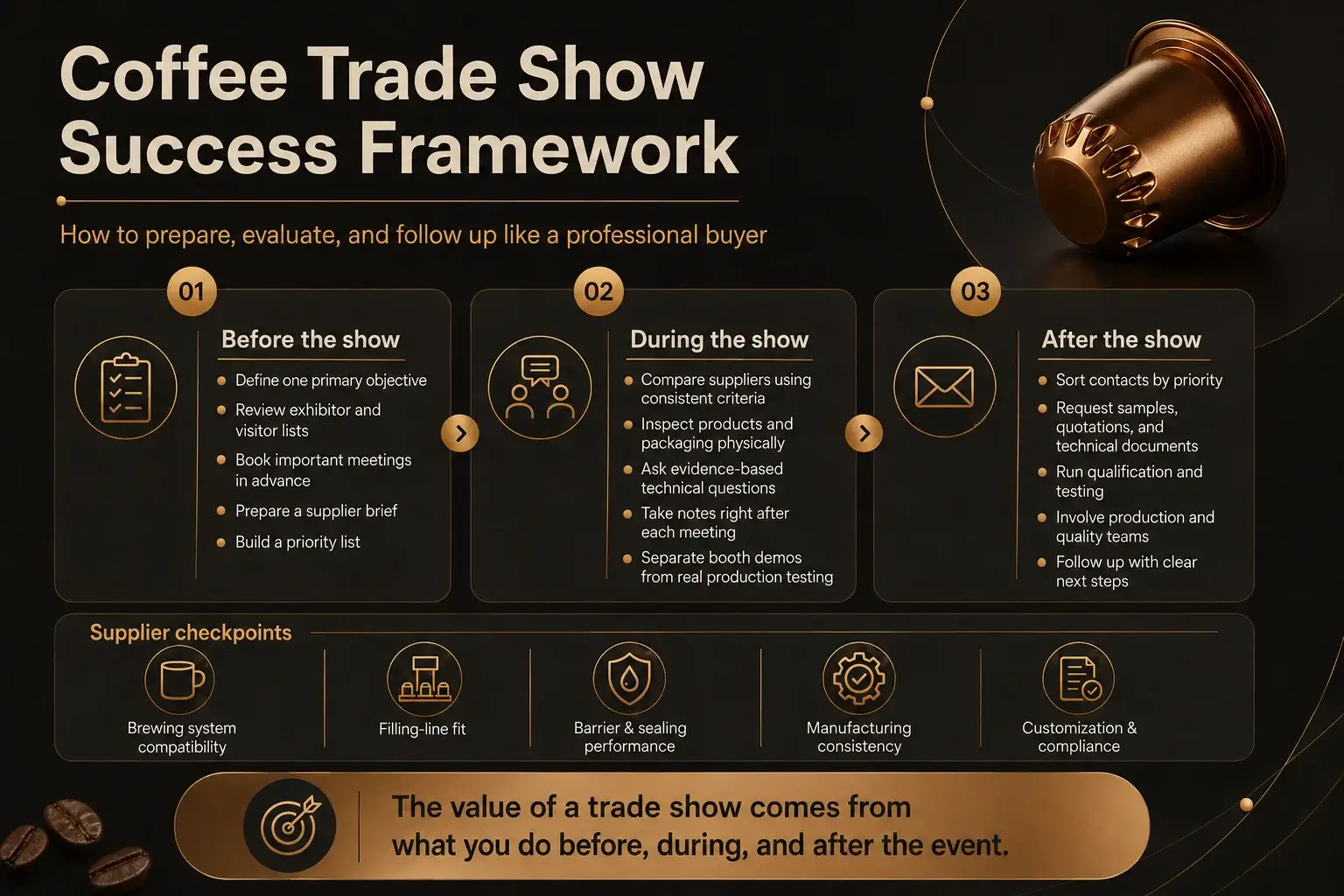
Much of the commercial value of an exhibition is created before the event begins. CBI recommends reviewing the event website, identifying relevant participants and speakers and scheduling meetings with key contacts in advance.
A professional preparation process can go further:
Build a priority list
Divide companies into groups. The first group contains businesses you must meet. The second contains companies you would like to meet. The third contains companies worth investigating if time permits.
This prevents a common trade-show problem: spending twenty minutes in an interesting but commercially irrelevant conversation while an important objective is neglected.
Contact important companies beforehand
Do not assume the person you need will be standing at the booth when you arrive. Large exhibitors may have salespeople, engineers, regional managers and senior executives rotating through different meetings.
If the discussion matters, arrange it. Explain why you want to meet and what you want to discuss.
Prepare a supplier brief
Buyers should also make it easy for suppliers to determine whether there is a realistic fit.
Depending on the project, the brief may include the capsule or brewing system required, current or expected volume, target markets, filling equipment, planned launch timing, customization requirements, relevant certifications, sustainability requirements and the stage of product development.
Not every detail needs to be disclosed during an introductory conversation, but a supplier cannot give useful answers without understanding the basic project.
Prepare questions that produce evidence
Avoid questions that invite a yes-or-no marketing answer and opt for a more specific or open-ended type of questions. The quality of the answer will tell you almost as much as the answer itself.
What to Do During the Exhibition
A large exhibition can quickly become information overload. The solution is to treat meetings as part of a structured evaluation process:
Take notes immediately after important discussions. Record which person you met, what was promised, which samples were supplied, which documents need to be sent and what the next action should be.
If several suppliers are being compared, use consistent criteria. Do not compare one supplier according to price, another according to appearance and a third according to technical sophistication. Decide which factors matter before the show and collect comparable information.
Be skeptical of absolute claims. The exhibition floor rewards simple messages. Procurement requires nuance. Ask how claims are defined and supported.
And remember that a successful booth demonstration is not a production trial. Samples still need to be evaluated under the conditions that matter to your business.
The Trade Show Is Not Finished When You Leave
A surprising amount of exhibition value can disappear during the days immediately following the event. A structured follow-up process avoids that.
Separate contacts into categories: Some require technical documents, others require samples, quotations or a second meeting. Some are interesting but not commercially relevant now, and others should simply be removed from the active pipeline.
For supplier evaluation, turn the conversation into a qualification process:
Request the agreed documents, arrange sample testing, involve production or quality personnel where appropriate, clarify commercial terms, check relevant certifications and documentation when necessary.
Only then does the initial trade-show conversation become a sourcing decision.
For sales leads, the principle is similar. Follow up on the subject actually discussed rather than sending a generic message to everyone who visited the booth.
Major Upcoming Coffee Trade Shows and Exhibitions: 2026–2027
The following calendar focuses on events with clear potential relevance to coffee businesses, roasters, capsule companies, private-label brands, café operators, suppliers or buyers.
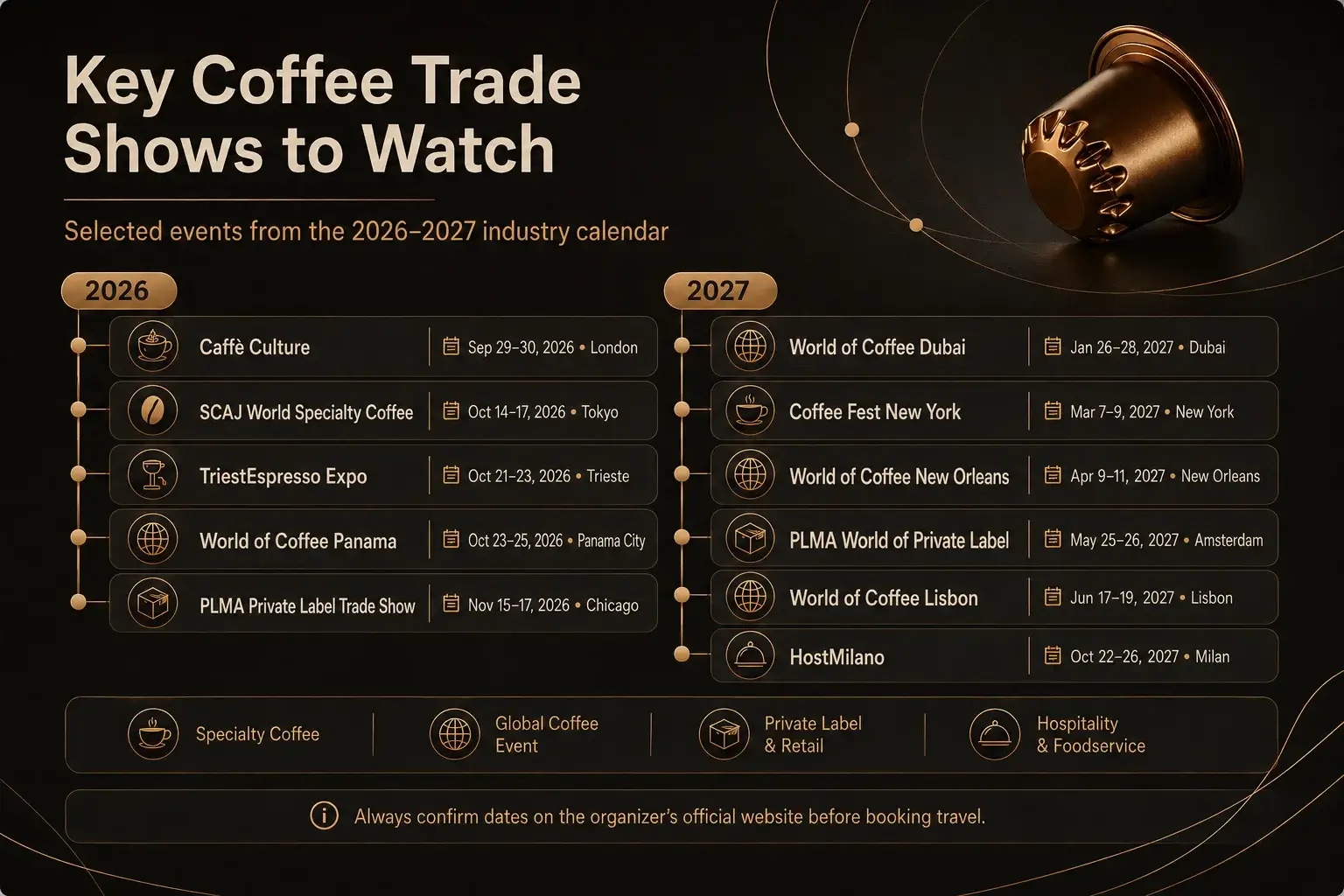
Event schedules can change, so dates should always be confirmed on the organizer’s official website before travel is booked.
Caffè Culture
September 29–30, 2026
Business Design Centre, London, United Kingdom
Caffè Culture is a trade exhibition focused on the UK specialty coffee and café-bar market. The organizer expects approximately 3,500 trade visitors, 120 exhibitors and more than 50 industry experts.
Best suited to: UK market development, roasters, café products, equipment and businesses selling to hospitality operators.
SCAJ World Specialty Coffee Conference and Exhibition
October 14–17, 2026
Tokyo Big Sight, Japan
The Specialty Coffee Association of Japan expects approximately 500 exhibiting companies and 95,000 visits across the four-day 2026 event. The exhibition brings together companies and professionals from Japan and the international specialty coffee sector.
Best suited to: companies researching or developing the Japanese and Asian specialty-coffee markets.
SIAL Paris
October 17–21, 2026
Paris Nord Villepinte, France
SIAL Paris is an international food-industry exhibition rather than a dedicated coffee show. The official 2026 dates are October 17–21.
For private-label coffee companies, manufacturers and suppliers, that broader audience can be an advantage because the event provides access to international food businesses, buyers and distributors beyond the specialist coffee industry.
Best suited to: international food-industry contacts, retail, distribution, product development and cross-category private-label opportunities.
Coffee Fest Dallas-Fort Worth
October 17–18, 2026
Fort Worth Convention Center, United States
Part of the Coffee Fest B2B series, the Dallas-Fort Worth event focuses on specialty coffee businesses and connects attendees with suppliers, educators and other coffee-industry professionals.
Best suited to: US café operators, roasters, distributors and suppliers.
International Coffee Convention
October 19–20, 2026
Trieste, Italy
The International Coffee Convention takes place immediately before TriestEspresso Expo. The program focuses on areas including climate, consumers, circularity, sustainability, science, health and innovation, with the stated objective of connecting scientific research with practical coffee-industry decision-making.
Best suited to: businesses interested in research, sustainability, science, innovation and longer-term developments affecting the coffee supply chain.
TriestEspresso Expo
October 21–23, 2026
Trieste, Italy
TriestEspresso is a dedicated international B2B exhibition for espresso and the coffee-industry supply chain.
The organizer expects more than 200 exhibitors, buyers from more than 50 countries and over 10,000 B2B visitors during the 2026 edition.
Best suited to: coffee manufacturers, roasters, equipment businesses, capsule suppliers and companies looking for partners across the industrial espresso supply chain.
World of Coffee Panama
October 23–25, 2026
Panama City, Panama
World of Coffee Panama is part of the Specialty Coffee Association’s international World of Coffee series. The official World of Coffee calendar confirms the October 23–25, 2026 dates.
Best suited to: specialty coffee businesses, producers, traders and companies developing relationships in Latin America and the international specialty-coffee sector.
PLMA’s 2026 Private Label Trade Show
November 15–17, 2026
Donald E. Stephens Convention Center, Chicago, United States
PLMA’s Chicago event focuses on store brands and private-label manufacturing. The show brings together retailers, manufacturers and sourcing partners. Its exhibition halls include food and beverage, while companies providing packaging, ingredients, supply-chain and logistics services are also eligible to participate.
Best suited to: private-label manufacturers, companies seeking US retail relationships, packaging suppliers and businesses targeting store-brand programs.
World of Coffee Dubai
January 26–28, 2027
Dubai World Trade Centre, United Arab Emirates
The official World of Coffee calendar confirms the January 26–28, 2027 Dubai edition.
Best suited to: businesses targeting the Middle East, specialty-coffee buyers, roasters, distributors and international coffee-industry contacts.
Coffee Fest New York
March 7–9, 2027
Javits Center, New York, United States
Coffee Fest New York is a B2B specialty-coffee exhibition serving coffee and hospitality professionals on the US East Coast.
The organizer currently lists the official event dates as March 7–9, 2027.
Best suited to: companies targeting specialty-coffee businesses and café operators in the eastern United States.
World of Coffee New Orleans
April 9–11, 2027
New Orleans Ernest N. Morial Convention Center, United States
The Specialty Coffee Association’s official calendar confirms the April 9–11, 2027 dates and New Orleans venue.
Best suited to: roasters, manufacturers, specialty-coffee suppliers and businesses targeting the North American professional coffee market.
World of Coffee Tokyo
April 28–May 1, 2027
Tokyo Big Sight, Japan
The Specialty Coffee Association’s official calendar confirms that World of Coffee Tokyo will run from April 28 to May 1, 2027.
Best suited to: specialty-coffee businesses seeking exposure and commercial relationships in Japan and the wider Asian market.
PLMA World of Private Label
May 25–26, 2027
RAI Amsterdam, Netherlands
PLMA’s World of Private Label brings retailers and manufacturers together specifically to develop private-label business. The organizer has confirmed May 25–26, 2027 at RAI Amsterdam.
PLMA reports more than 3,300 exhibitors representing 80 countries, making the event particularly relevant to businesses looking beyond coffee-specific sourcing channels.
Best suited to: private-label manufacturers, retailers, contract suppliers, packaging companies and businesses seeking European retail partners.
Coffee Fest Chicago
June 11–12, 2027
Navy Pier, Chicago, United States
Coffee Fest Chicago brings suppliers together with independent coffee businesses, roasters, distributors and other industry professionals.
The official event page confirms June 11–12, 2027 at Navy Pier.
Best suited to: US roasters, cafés, suppliers, distributors and specialty-coffee businesses.
World of Coffee Lisbon
June 17–19, 2027
Lisbon Exhibition and Congress Centre, Portugal
The Specialty Coffee Association has announced that World of Coffee Europe will take place in Lisbon from June 17–19, 2027, marking the first World of Coffee event held in Portugal.
Best suited to: European and international specialty-coffee networking, supplier research, product discovery and market intelligence.
World of Coffee Bogotá
September 30–October 2, 2027
Bogotá, Colombia
The Specialty Coffee Association’s current World of Coffee calendar lists Bogotá for September 30–October 2, 2027.
Best suited to: producers, traders, roasters and international businesses developing relationships with the Latin American coffee supply chain.
HostMilano
October 22–26, 2027
Fiera Milano Rho, Milan, Italy
HostMilano is an international professional exhibition covering hospitality, catering, food service and related technologies. The organizer has confirmed its next edition for October 22–26, 2027.
For coffee companies, its relevance is particularly strong where coffee intersects with professional equipment, hospitality, automation and food-service operations.
Best suited to: equipment companies, manufacturers, hospitality suppliers, coffee brands and businesses monitoring professional coffee technology.
A Final Checklist Before You Book the Next Coffee Trade Show
Before committing to an event, a coffee business should be able to answer five questions clearly.
- Who specifically do we want to meet?
- What decision or commercial objective should the exhibition help us advance?
- Are enough of those people or companies likely to be there?
- What information, samples or meetings do we need to arrange before attending?
- What will we do with the contacts and information afterward?
If the answers are vague, the exhibition strategy is probably vague as well.
If the answers are specific, the event becomes much easier to evaluate.
Final Thoughts
NovoCapsule has worked with private-label coffee businesses and roasters across international markets and has participated in coffee, food and private-label industry exhibitions itself.
For companies evaluating Nespresso-compatible aluminum capsules, a trade show can be an excellent place to begin the conversation. The actual supplier decision, however, should be based on technical performance, manufacturing consistency, documentation, compatibility, commercial fit and the supplier’s ability to support the product after launch.
If you are currently evaluating aluminum coffee capsules for a new or existing private-label coffee range, contact NovoCapsule to discuss your brewing system, filling requirements, volumes, customization needs and target markets.
Frequently Asked Questions
How should a coffee company measure the ROI of a trade show?
Trade-show ROI should not be measured only by immediate sales. For B2B coffee companies, meaningful indicators can include qualified leads generated, meetings with target accounts, supplier relationships initiated, samples requested, technical evaluations started, distribution opportunities created and deals that enter the sales pipeline after the event.
Because procurement and private-label sales cycles can be long, companies should evaluate results again several months after the exhibition rather than judging performance only during the first few days after returning.
Who should a company send to an international coffee exhibition?
The team should reflect the purpose of the visit. A sales representative may be sufficient when the objective is lead generation or distributor development, while supplier evaluation often benefits from having someone who understands production, quality or technical requirements.
For companies assessing capsules, filling equipment or other production components, having access to technical expertise can make supplier meetings considerably more productive.
How many coffee trade shows should a company attend each year?
There is no ideal number. A company may gain more value from one or two carefully selected exhibitions than from attending numerous events without clear commercial objectives.
The decision should depend on available budget, target markets, product-development priorities, customer locations and how much meaningful follow-up the team can realistically handle after each show.
When does it make sense to return to the same exhibition every year?
Repeated attendance can make sense when an event consistently attracts important customers, suppliers or partners and has become part of the industry’s annual business cycle.
Returning can also strengthen relationships because contacts who were exploratory during one exhibition may become active commercial opportunities by the following year. If the audience, market or strategic value has changed, however, companies should reassess the event rather than attending automatically.
How can companies protect confidential information during trade-show meetings?
Initial conversations should provide enough information to determine whether a potential partner is relevant without disclosing unnecessary proprietary details.
Sensitive information such as unreleased product specifications, formulations, manufacturing processes, pricing structures or strategic plans can be reserved for later discussions. Where substantial confidential information needs to be exchanged, companies may choose to put an appropriate confidentiality agreement in place before sharing it.
How can smaller coffee brands compete for attention at large exhibitions?
Smaller companies do not necessarily need the largest booth to have productive meetings. Advance scheduling, a clear value proposition and a well-defined target list can be more important than exhibition scale.
A smaller brand can also concentrate on a narrow group of highly relevant buyers or suppliers rather than trying to generate maximum booth traffic. In B2B exhibitions, a small number of well-qualified conversations can be more valuable than a large number of casual visitors.
Are virtual meetings still useful after meeting someone at a coffee trade show?
Yes. The exhibition usually serves as the beginning of a commercial relationship rather than the entire process.
Video meetings are particularly useful for bringing additional technical, procurement, quality or management personnel into the discussion after the initial face-to-face meeting. They can also help clarify specifications, review samples and move a project forward before a factory visit or production trial becomes necessary.

